
All Categories
Fine lines, enlarged pores, uneven skin texture and loss of firmness are common concerns in aesthetic skin rejuvenation. While traditional skincare mainly focuses on the skin surface, injectable skin boosters are designed to work within the skin to support hydration and overall skin quality.
Among biostimulatory approaches, PLLA skin boosters are gaining attention for their potential to support progressive collagen stimulation while improving the overall appearance of the skin.
PLLA, or poly-L-lactic acid, is a biodegradable polymer that has been widely studied in aesthetic medicine for its collagen-stimulating properties.
Unlike treatments designed primarily to provide immediate volume, PLLA works progressively. After treatment, the material gradually biodegrades while stimulating a biological response associated with collagen production.
This progressive mechanism makes PLLA particularly relevant when the treatment goal is not simply adding volume, but improving the quality, firmness and texture of the skin over time.
A 2024 systematic review of PLLA in facial aesthetics reported improvements across several aesthetic outcomes, although the authors also noted limitations in the available clinical evidence.[1]
Fine lines can become more visible as collagen and skin elasticity decline with age. They may appear around the eyes, mouth and other areas where the skin is frequently exposed to movement.
A PLLA skin booster may be considered as part of a skin rejuvenation approach when the goal is to support collagen stimulation rather than create significant structural volume.
As collagen remodeling develops progressively, the treatment concept focuses on improving the underlying quality of the skin.
For clinics, this makes PLLA skin boosters relevant to patients looking for a gradual skin rejuvenation approach rather than an immediate volumizing effect.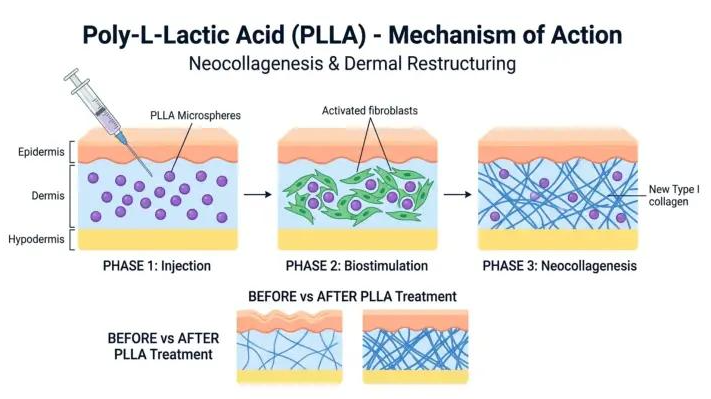
Enlarged pores are often associated with oil production, follicular structure, skin aging and reduced elasticity. Because pore appearance can have multiple causes, no single injectable treatment should be considered a universal solution.
However, improving overall skin quality and firmness may contribute to a smoother-looking skin surface.
This is one reason why PLLA-based skin rejuvenation is sometimes considered when enlarged pores occur together with loss of firmness, uneven texture or early signs of skin aging.
The focus is therefore not on “shrinking pores” directly, but on supporting the skin's overall structure and quality.
Uneven texture can include roughness, reduced smoothness, visible fine lines and a lack of skin firmness.
For these concerns, the treatment concept of PLLA is based on progressive biostimulation rather than simple surface hydration.
A PLLA skin booster containing HA can combine two complementary functions:
Research on injectable HA has also reported improvements in facial skin-quality parameters such as hydration, firmness, texture and elasticity, although study protocols and outcomes vary.[2]
This combination can make PLLA + HA formulations relevant for clinics looking to address multiple aspects of skin quality within one treatment concept.
Depending on the formulation and professional treatment protocol, PLLA skin boosters may be considered for patients concerned about:
The specific treatment approach should always be selected according to the product formulation, treatment area and individual patient assessment.
The key difference between a PLLA skin booster and a conventional topical skincare approach is its injectable, biostimulatory mechanism.
Rather than focusing only on surface hydration, PLLA is studied for its ability to stimulate a progressive collagen response. When combined with HA, the formulation can also provide a hydration component.
This makes PLLA skin boosters particularly interesting for skin-quality-focused rejuvenation, especially when fine lines, texture changes and reduced firmness appear together.
PLLA is generally associated with a progressive treatment effect rather than relying solely on immediate visible volume. The collagen-stimulation process develops over time.
It may be considered when enlarged-looking pores are associated with reduced firmness or uneven skin texture. However, pore appearance can have multiple causes, so outcomes vary.
Not necessarily. Treatment suitability depends on individual skin concerns, treatment goals and professional assessment rather than age alone.
They serve different treatment concepts. A PLLA skin booster is positioned primarily around skin quality and biostimulation, while a PLLA dermal filler is generally used when structural volume or contouring is the primary objective.
For a broader explanation, see our guide to [What Is a PLLA Skin Booster?] and our product page for the PLLA Skin Booster.
PLLA skin boosters are designed around a progressive approach to skin rejuvenation. By supporting collagen stimulation, PLLA may be relevant to aesthetic concerns such as fine lines, uneven texture and reduced firmness.
When combined with HA, the formulation can bring together progressive collagen stimulation and hydration, making it a potential option for clinics focusing on comprehensive skin-quality treatments.
As with any injectable aesthetic treatment, product selection and treatment protocols should be determined by qualified professionals based on the individual patient and the specific formulation.
Copyright © 2026 DermalFillerX All Rights Reserved. POWERED BY UEESHOP


